
Screenshots


About this app
Dead Cells puts you in control of the Prisoner, an amorphous character exploring a plague-ridden island filled with mutated enemies. Its central benefit is the way each run combines immediate action with meaningful long-term progress: you can experiment with weapons, learn enemy behavior, collect Cells, and unlock permanent options even though most equipment from a failed attempt is lost. The game is built around quick movement, difficult encounters, changing dungeon layouts, and repeated practice, making every journey both a combat challenge and an opportunity to understand the island more effectively.
A roguevania built around repeated runs
Dead Cells combines the random structure of a roguelike with the exploration and route-opening ideas associated with Metroidvania games. The Prisoner travels through a sequence of levels and biomes assembled from predesigned sections in different configurations. Enemy positions and item placements can change between visits, so a familiar area can still require a different approach. This structure supports short, repeatable attempts while keeping exploration relevant, particularly as new routes and travel options become available.
Death is an important part of the design rather than an occasional setback. Weapons and upgrades collected during a run are generally lost when the Prisoner dies, while a smaller group of permanent items remains available. Cells collected from defeated enemies can be spent on lasting upgrades, but they must be carried to the end of a dungeon section before they can be used. If the Prisoner dies before reaching that point, the unspent Cells are lost. The result is a balance between taking risks for greater progress and protecting what has already been earned.
Movement and combat reward careful reactions
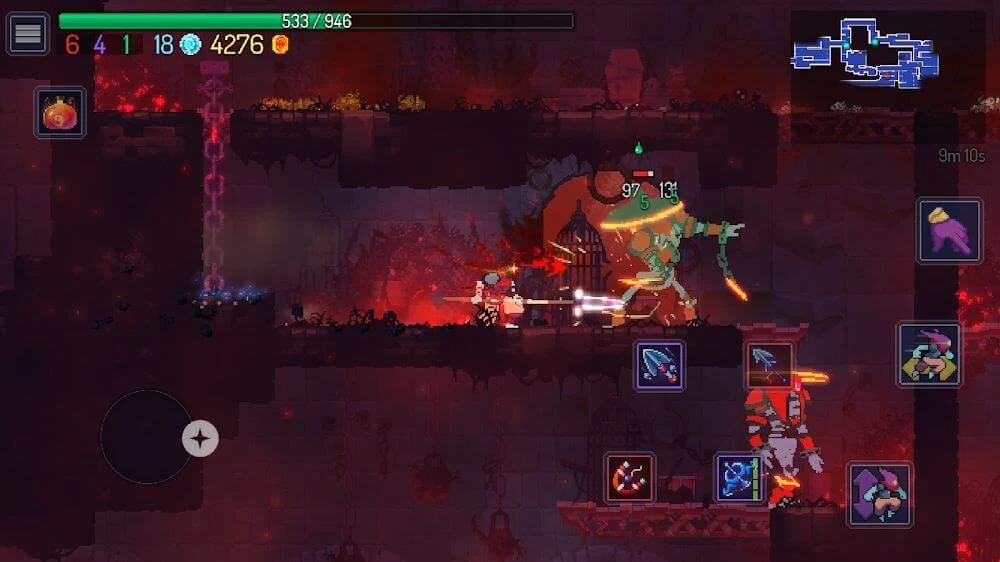
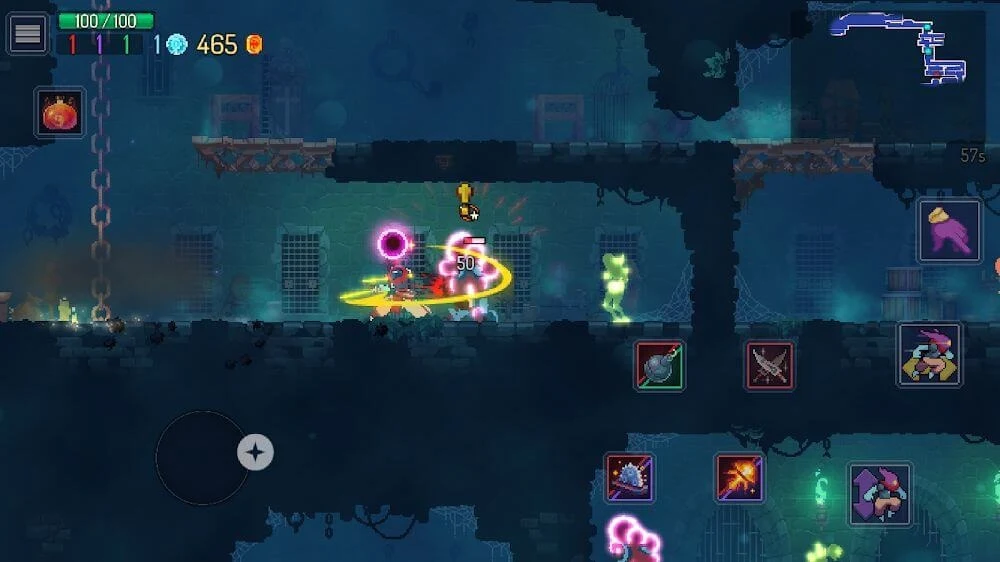
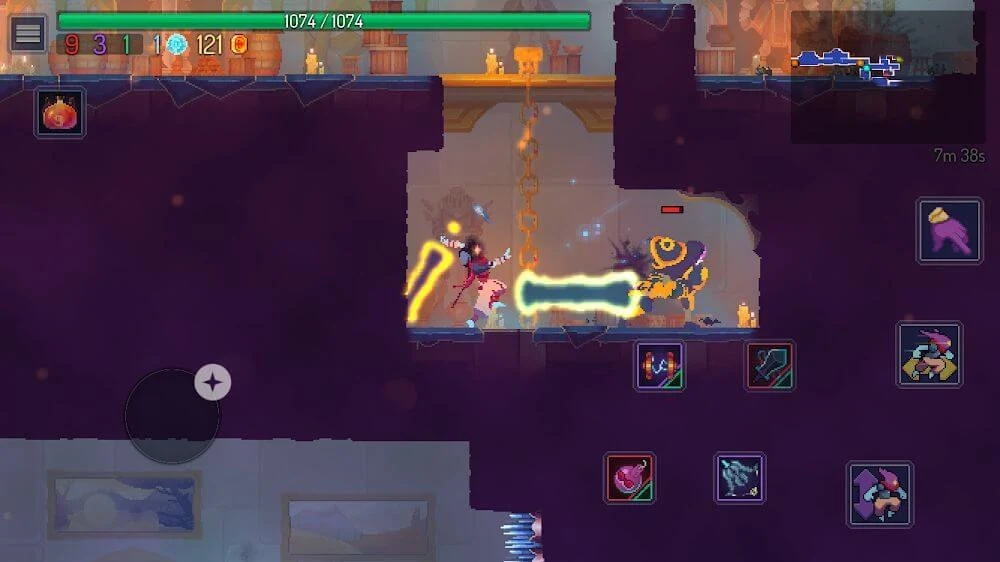
Combat uses swords, bows, shields, and deployable traps, giving the Prisoner several ways to handle an encounter. The character can dodge along the ground, jump over attacks, or dodge through an enemy’s position to move behind it. Falling attacks add another option: a ground slam can stun nearby enemies, while a controlled fall can help the Prisoner descend without being stunned. These actions make positioning as important as choosing a weapon.
Enemies have recognizable behaviors that can be studied over time, but individual encounters can become much more dangerous when several opponents work together. A flying enemy, a bomber, and a stronger elite opponent may force the player to manage several threats at once. Rather than rushing directly into a group, it can be useful to observe enemy placement, separate opponents where possible, and retreat toward an area that has already been cleared. A safe fallback gives skills time to recharge and can make pursuing enemies approach in less coordinated ways.
Weapons, mutations, and combat builds
Weapon variety is central to how each run develops. Swords support close-range attacks, bows allow distance, shields help with defense, and traps can damage enemies that move into their range. Weapons also carry different effects, so combining them with the right situation can change how an encounter unfolds. Cells can unlock additional weapons and other options that may then appear during later playthroughs, gradually widening the range of possible builds.
During a run, the Prisoner can find Power Scrolls that improve health and weapon damage according to the chosen classification: Brutality, Tactics, or Survival. These categories encourage different approaches without forcing every attempt to use the same equipment. Mutations provide additional bonuses and can be selected between dungeons, but they last only until death. At resting points, the player can adjust these benefits to suit the current pace of the run. Weapons can also be reforged between dungeons to give them new combat effects, allowing an otherwise useful item to fit a developing build more closely.
Runes and permanent exploration options
Some dungeons contain permanent upgrades called Runes. These are obtained by defeating powerful Elite enemies, and the progression requires one Rune before the next can be acquired. Their purpose is to add new ways to travel through levels, so exploration expands as the player continues to uncover them. Runes therefore connect combat progress with navigation: defeating a demanding opponent can provide more than immediate rewards by opening methods of reaching areas that were previously inaccessible or harder to approach.
Blueprints offer another form of lasting discovery. When found inside a dungeon, a blueprint must be carried out of the level before it is collected successfully. This creates an additional risk during exploration, since discovering a new option is not enough; the Prisoner must also survive long enough to extract it. Together, Runes, blueprints, and Cell purchases give repeated attempts a clear purpose even when a particular run ends before the final stages.
Practical habits for surviving longer
The game’s speed does not mean every action should be rushed. Learning enemy patterns, watching how opponents are positioned, and using elevation can make difficult areas more manageable. Many enemies react when the Prisoner reaches their level, so different platforms and ledges can help control when a fight begins. A ground slam performed behind an enemy or above a grouped set of opponents can create a brief opening, giving the Prisoner time to attack before the group responds.
Healing also requires judgment. Using a health flask during an active fight leaves the Prisoner vulnerable, so it is safer to finish the encounter or reach a calm area first unless a selected mutation changes the timing. Damage-over-time effects such as poison, bleeding, fire, and shock can continue to pressure an enemy after the Prisoner moves away, although stacking effects may alter the timing of some powerful opponents. Finally, patience helps turn the game’s fast combat into a learnable routine. A kill-streak display can be enabled through the gameplay options, making it easier to track consecutive kills without taking damage and practice the consistency needed for higher difficulties.
Who may appreciate the structure
Dead Cells is suited to players who enjoy demanding action, repeated attempts, and gradual mastery rather than a single uninterrupted progression path. Its changing layouts provide variety between runs, while Cells, blueprints, mutations, and Runes give successful exploration lasting value. The game also leaves room for different play styles through its weapon categories, combat effects, traps, defensive tools, and movement techniques. Players who prefer to study opponents, make route decisions, and improve through failure will find that the run-based structure supports that process directly.
Version history
View all27 Aug 2026 · stable
Frequently asked questions
What happens to equipment when the Prisoner dies?
Weapons and upgrades obtained during the run are generally lost on death, while some permanent items remain available.
How are Cells used?
Cells collected from defeated enemies can be spent at the end of a dungeon section to purchase permanent upgrades, including options such as additional weapons or health-restoring potions. Cells that have not been spent are lost if the Prisoner dies before reaching that point.
What are Mutations?
Mutations are temporary bonuses selected between dungeons. They improve the Prisoner’s capabilities during the current run and last until death.
How do Runes affect exploration?
Runes are permanent upgrades obtained by defeating powerful Elite enemies. They provide new methods of travelling through levels, with later Runes requiring earlier ones.
What do Power Scrolls improve?
Power Scrolls increase the Prisoner’s hit points and improve weapon damage according to the weapon classification of Brutality, Tactics, or Survival.