
Screenshots
About this app
The Room: Old Sins is an adventure puzzle game in which you explore an ancient dollhouse and search for precious artifacts linked to the mysteries of a manor. Progress comes from examining nearby objects, manipulating strange mechanisms, and observing details that reveal hidden compartments or new routes. The game combines tactile touch interaction with a story about the disappearance of an engineer and his wife.
Exploring the dollhouse
The dollhouse acts as the central structure for the adventure. Its rooms contain different architecture, devices, books, and objects that must be examined closely. A discovery in one area can provide something needed elsewhere, so the investigation moves between connected spaces rather than keeping every puzzle inside a single room.
Early progress begins in the Foyer. Opening an artifact found there provides a swan figurine, which can be placed on a statue pedestal. This opens a compartment containing a miniature lamp. Attaching the lamp to its proper position illuminates more of the dollhouse and makes the Study available. This sequence demonstrates how an object found in one part of the model can change the spaces that can be explored.
Manipulating mechanical objects
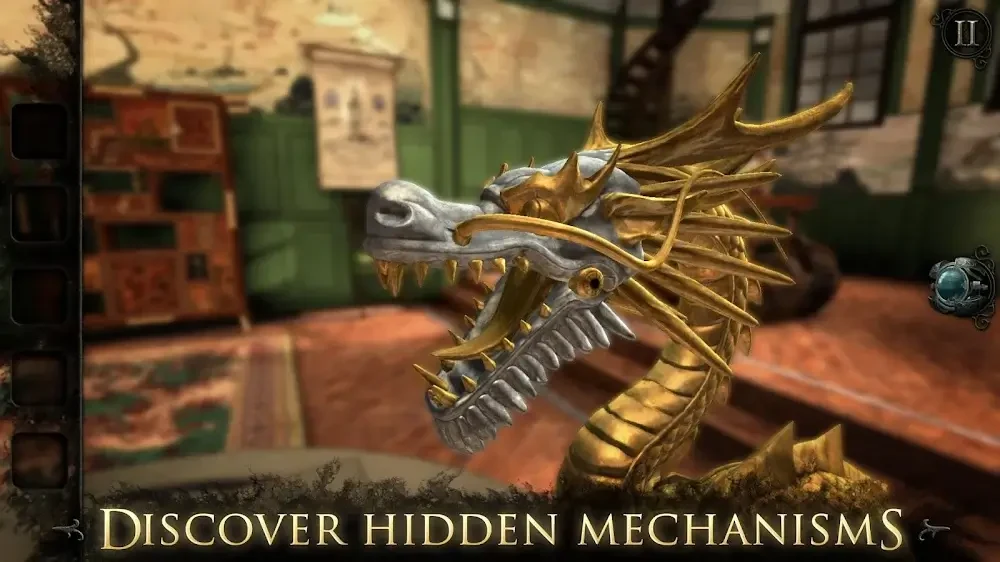
The main puzzle interaction is physical and object-focused. You can slide panels, turn knobs, pull levers, rotate objects, find concealed switches, and connect mechanical components. The source also describes roll-top desks, steam-powered machines, stoves, service bells, floor grates, water pipes, dumbwaiters, radios, safes, and model vehicles as parts of the investigation.
These devices are not presented as isolated minigames. In the Study, solving desk puzzles reveals a model well that can be placed in the yard of the dollhouse, opening the route to the Kitchen. In the Kitchen, a model water pump begins supplying water after it is positioned correctly. Water can later be redirected between rooms and converted into steam power for machines in the Study. These connections make room-to-room experimentation part of the puzzle structure.
Using the eyepiece and superzoom
The eyepiece is a key tool for finding details that are not immediately visible. It can reveal markings, secret compartments, and traces of the Null element. In the Study, the superzoom mechanic allows the eyepiece to enter small apertures, creating a miniature view in which additional mechanisms can be inspected and operated.
The eyepiece also changes how certain objects are understood. In the Curiosity Room, it reveals a vase on a pedestal and helps expose details inside an anatomical model. Entering the model through the superzoom lens triggers a scene involving Edward and Abigail. Elsewhere, the tool helps identify objects that appear absent or incomplete during a normal inspection, so careful viewing is directly connected to discovering the next interaction.
Room-based puzzle progression
Each newly opened room adds another group of objects and extends the investigation. The Study contains a roll-top desk, steam machines, a model well, and books that describe Edward's growing involvement with the Circle and the Null. Solving a model train puzzle opens the desk and reveals another book, while a model chimney placed on the house unlocks the Curiosity Room.
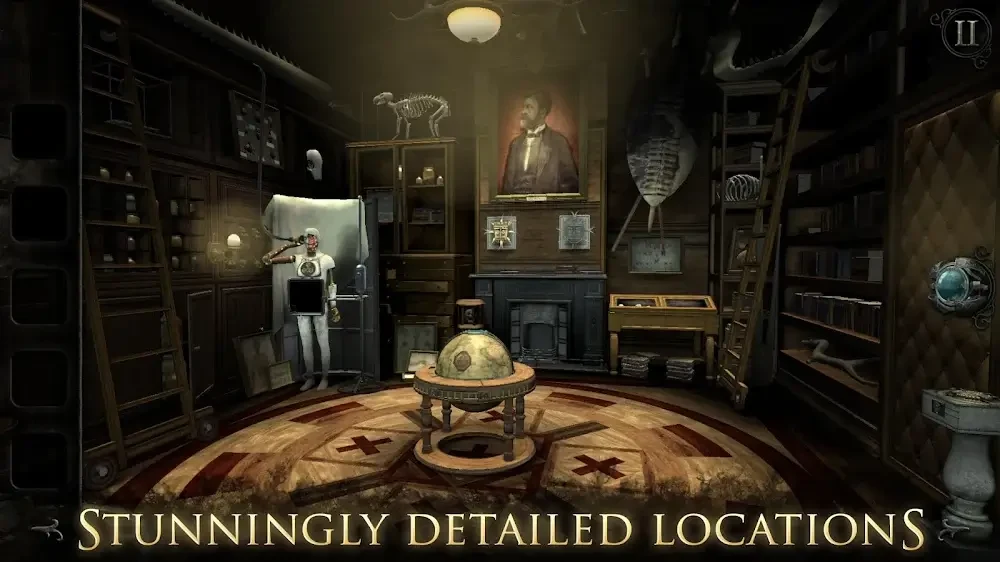
The Curiosity Room includes a globe, an anatomical model with a listening tube, a jewel case, masks, and a pedestal. Solving puzzles involving these objects leads to the recovery of an artifact from the Study and opens further changes in the dollhouse. An artifact can also alter a room: the Study is taken over by the Null after its artifact is collected, and the room's seal becomes overgrown.
The Maritime Room becomes available after a weather vane is placed on the dollhouse. It contains a radio, speaking tube, safe, harpoon gun, model submarine, and a dumbwaiter connected to the Kitchen. A mechanical heart found in an iron pot can be fitted into the model in the Curiosity Room. Activating the radio and using that model helps translate garbled messages into coordinates for a submarine puzzle, which leads to a pendant and another stage of the investigation.
The Garden is unlocked with a miniature engraved roof obtained from the Curiosity Room. Its fountain, wall mechanisms, carved stone face, and empty pool form another collection of linked puzzles. A pipe section can connect the Kitchen's water supply to the garden fountain, after which further Garden interactions provide ironwork for the dollhouse exterior. This placement opens another Kitchen puzzle and leads toward recovery of that room's artifact.
Story clues through objects and books
The narrative develops as rooms are explored and puzzles are solved. Books found throughout the dollhouse provide separate accounts of Edward and Abigail's experiences. Their entries describe the Circle's influence, Edward's growing obsession with the Null, Abigail's attempts to warn him, and the increasingly distorted dimensions of their home.
Environmental details and puzzle results add context to these written clues. In the Curiosity Room, the eyepiece-assisted view shows an argument between Edward and Abigail, while later examination of the damaged vase leaves behind a model weather vane. In the Maritime Room, books connected to the submarine and ocean navigation add more information about their conflict. The missing couple and the mysterious artifact at the center of the story are therefore investigated through both mechanical progress and discovered narrative material.
Controls, atmosphere, and account features
The game is designed around touch interaction with the dollhouse and its objects. Its documented interactions focus on direct gestures such as sliding, turning, pulling, rotating, and inspecting from different angles. Atmospheric audio accompanies the exploration and contributes to the eerie setting without replacing the object-based puzzle solving.
The game supports multiple languages. It also allows players to log in to the same account on multiple devices, supporting continuation of the same adventure across those devices. The available information does not specify particular languages or additional device requirements.
Version history
View all26 Mar 2026 · stable